Most of our clients are (by nature) entrepreneurial. They make swift decisions and implement them It is difficult to understand why a deal process takes so long and, to be frank, it shouldn’t. But 30 years’ experience shows that it (sadly) does; so I thought I would try and unpick why !
A transaction process usually has four phases; Preparation, Marketing, Negotiation and then Due Diligence & Legals. The first three take place before Heads of Terms are agreed and the last follows agreement of Heads and (usually) the granting of exclusivity to a single bidder.
Preparation
Preparing properly for a transaction process is labour-intensive, and this phase can be protracted if information is not readily available, management are not focused on getting through it quickly or issues come to light while preparation is ongoing.
Before one can move to the marketing phase it is best to be properly ready for the rest of the process. Nothing derails a process like a loss of momentum and momentum is best achieved through the ability to swiftly and comprehensively prepare the information you will be asked for and responses to the questions that you will be asked.
There are three key elements to being properly prepared to “press the button” on a process;
The Information Memorandum; The Info Memorandum is a selling document which presents the business, its background and its value drivers while also explaining its infrastructure, cost and customer base and financial performance – historic, current and future. The Info Memorandum should stand alone of any other information base in presenting all aspects of the business coherently to a potentially interested party.
The Financial Data; Any potentially interested party will ultimately want to gain a deep understanding of the financial dynamics of the business. To be properly prepared, detailed summaries of historic financial performance, current trading and financial forecasts for the next 3-5 years should be carefully compiled. Any logical weakness, factual inconsistencies or unsupported assumptions will be the subject of intense challenge later in the process. Good advisers at this stage will help you to understand the areas which are likely to be subject to the most scrutiny to help you address any contentious issues or potential challenges ahead of the game.
The Data Room: In the olden days, the data room was literally that. A meeting room with a lockable door where one could put all the financial, legal and commercial information in neatly labelled files, ready for due diligence teams to visit. Now, thankfully, data rooms are virtual, usually hosted by a legal firm, but still effectively organized as a series of carefully structured files, making it easy for due diligence providers to find what they need. The good news about virtual data rooms is that you can allow people in and out at will, so if someone pulls out of the process, or negotiations falter, you can instantly close their access to information down.
For some businesses where there is particular complexity or where the bidding EBITDA in the process is quite different (due to growth, adjustments etc) to the statutory accounts profitability and/or where you want to run a very aggressive process then it is worth considering investing in Vendor Due Diligence in this preparation phase. VDD is due diligence which the vendors scopes and funds but which is then available for interested parties to rely on. While in most cases, any bidder will want to top up or supplement that diligence, it does provide enough details to delay the grant of exclusivity until later in the process and can, therefore, be worth the spend. VDD used to be the preserve of the largest and most complex investment banking type processes, but is now prevalent in the mid-market.
During the course of the preparation phase, it should be possible to identify and fix information gaps, potential issues or inefficiencies which will affect the final consideration or untapped opportunities in terms of value enhancement. For this reason, together with vendors having usually to focus on the day job as well, the preparation phase of a process can take anything from a month to several. Allowing for 2-3 months in a well-organised and resourced business, is sensible.
Marketing
During the marketing phase of the process, we approach potential acquirers and/or investors. This is highly targeted to ensure that information is not shared pointlessly with parties that either have no appetite or lack the resources to do the deal. Accordingly during the preparation phase above, considerable work will have been done to identify an appropriate list of individuals to approach.
It can take several weeks to get in active touch with the right parties, agree and exchange NDAs and get the Information Memorandum into the right hands. Particularly when we approach large overseas corporates on behalf of our clients, their internal approvals, even to sign an NDA, can take a frustratingly long time.
Once the Information Memorandum is in the right hands, it is normal to offer potentially interested parties a meeting with the management team. This is typically structured as a presentation with a managed Q&A session. It gives potential bidders the opportunity to explore the specific aspects of the business that are interesting to them and also gives everyone the opportunity to evaluate “chemistry”. It is particularly important for would be PE investors or acquirers, but these days there are very few trade buyers who feel comfortable bidding off a document alone, so management presentations are equally prevalent in trade processes.
Before and after the management presentations, there will be a period of Q&A, when interested parties seek to ensure they have fully understood the information in the Information Memorandum and that they have supplemented it with any key questions they may have.
Simply the time taken to schedule presentations can easily take a few weeks, again particularly when dealing with overseas parties who must bring teams from abroad.
At the end of the marketing phase, a typical process will result in a short list of parties who continue to want to make an offer for the business having received the information memorandum, answers to their questions and having met management. At this point it is normal to issue a process note seeking indicative bids. Depending on how competitive the process is, one can either be very prescriptive about the format of bids or not. Either way, one might have to wait a couple more weeks while the potential bidders navigate their internal discussions and approval processes to get them to an indicative bid point.
You can see, therefore, how the Marketing Phase might easily take two to three months.
Negotiation
This can be a relatively short phase of the process. Sometimes there is a clear preferred bidder for the business who has submitted an offer that is, in essence, acceptable. Under these circumstances the purpose of this phase is to clarify the offer to ensure a clear understanding of all its elements, to negotiate any elements which are not acceptable (and which are negotiable) and then to agree heads of terms with that party.
More often, however, the indicative bids received will not be directly comparable and there will be elements of different bids that are preferable. For example, you might need to compare a higher enterprise valuation but a less attractive deal structure (more deferral perhaps, or an element of earn out) with a more straightforward structure (eg cash at completion) but a lower price. Then there are often lots of non-fiscal considerations such as business fit, opportunity for the management team, warranty and indemnity requirements and the level and timescales for due diligence. Your advisers will help you navigate and prioritise the factors you need to focus on and then there will usually be a period of negotiation with one or two parties to push the best offers received to the point where they are not only acceptable but optimized and where you perceive that the “pips have squeaked” on the other side.
Sometimes, in a very competitive process, indicative bids are so similar, or the competition to acquire or invest in the business is so fierce that it is worth running a second bidding round. In this case, one would normally release some additional financial information or updates as well as communicating what you like and done like about individual bids. This adds further time to this stage of the process but is obviously worthwhile in terms of typically improving the terms.
Either way, once there is agreement on both sides that mutually acceptable terms have been agreed, then it is normal to have a written heads of terms document. This is, in effect, a written handshake. The only legally binding clauses are usually exclusivity, the applicable legal jurisdiction and confidentiality. Heads of Terms can be drafted as a very light summary of the anticipated terms which is relatively easy to agree, or they can be very detailed, as a way of pre-empting some of the detailed negotiations later on. In that case, the negotiation of heads of terms can be protracted and since pre due diligence the debates tend to be somewhat theoretical, a balance is usually wise. Detailed and complex negotiations of heads can undermine the buyer/seller relationship if not very careful so it is best to take advice on what can and cannot sensibly be negotiated at this point.
As with other phases, this one can be very short or protracted by bidding rounds, negotiation, and agreement of heads of terms. On average it would be sensible to assume another 6-8 weeks.
Due Diligence and Legals
These elements of the process run in tandem, at least in the latter stages.
The quantity and breadth of a due diligence process will depend on who the buyer or investor is and how much understanding they already have of the market and the business itself. For example, a trade buyer will typically limit their scope to financial and legal due diligence processes and may do some of the financial analysis in-house rather than using external advisers. A Private Equity acquirer or investor is likely to deploy the full gamut of due diligence enquiries including not only financial and legal but also commercial due diligence, management due diligence, insurance due diligence and their process will therefore take longer.
In either case the due diligence will begin before any legal documents are drafted. This makes sense. However, detailed the heads of terms are, a significant proportion of the bulk of a Share Purchase Agreement will relate to warranties and it is difficult to draft warranties until due diligence is substantially underway and key risks and liabilities understood.
It can take a couple of weeks to get the due diligence process up and running. Advisers have to be lined up, scopes and fees agreed and letters of engagement signed. The process proper normally begins with an all parties meeting so that management can explain the business and how it works, setting the context for the detailed analysis that the diligence providers will undertake.
The most protracted due diligence processes are the fault of the vendor. If the information is not readily available in the data room so that the diligence providers can start work, their clients will not want them to dig in. It is expensive to have due diligence teams sitting around waiting for drip fed data, so (going back to the preparation phase) this needs attention throughout the process to this point to ensure deal readiness at the moment it is needed.
Even the most straightforward and efficient due diligence processes are likely to take six to eight weeks. Once information is reviewed there will be questions to answer, supplementary information to provide, meetings to schedule, perhaps overseas visits to schedule and once all the information is available there are formal reports to draft and review. It is helpful to ensure that diligence is being structured so as to cover key points early on and to ensure that any “red flags” are identified and discussed early on. By doing this it should be possible to ensure that any material issues and their potential value impact are exposed immediately and not left to the end of the process as bargaining “chips”.
Of course, if issues do arise in due diligence, then the time taken to understand them, quantify them, debate and agree a way through them, will create delay in the process. Typically, if the issue is potentially deal-threatening in its impact then all other workstreams would cease until it is resolved.
Once the bulk of the diligence has been undertaken then the lawyers will start to draft legal documentation. Provided the process has been well run, big surprises at this stage of the process should be unusual. However, there is a timescale attached to the draft – respond – comment – conclude process that is associated with these documents and that can take several weeks. Vendor and acquirer/investor lawyers will usually work amongst themselves to get to a largely agreed set of documents, with key or unresolvable points being brought back to the principals to agree with the help of their advisers.
At length, a fully agreed set of legal documents is arrived at which all parties can accept and that is when the process is finally ready to conclude with legal completion.
Exclusivity is usually granted for 8 weeks but most often gets extended by a further month or even more. Certainly, this final phase of the process can regularly take three months.
Conclusion
In addition to the above, the simple fact of a process is that it involves many work streams and many, many individuals (particularly in the final phase). For this reason, holidays, sickness, the need to protect the business from the process being apparent and conflicting obligations like conferences, board meetings etc. all create mini hold-ups on the way through.
Perhaps having considered the process from beginning to end it is more surprising that any deals happen within less than a year than that they can take that long to conclude!
Most of our clients are (by nature) entrepreneurial. They make swift decisions and implement them It is difficult to understand why a deal process takes so long and, to be frank, it shouldn’t. But 30 years’ experience shows that it (sadly) does; so I thought I would try and unpick why !
A transaction process usually has four phases; Preparation, Marketing, Negotiation and then Due Diligence & Legals. The first three take place before Heads of Terms are agreed and the last follows agreement of Heads and (usually) the granting of exclusivity to a single bidder.
Preparation
Preparing properly for a transaction process is labour-intensive, and this phase can be protracted if information is not readily available, management are not focused on getting through it quickly or issues come to light while preparation is ongoing.
Before one can move to the marketing phase it is best to be properly ready for the rest of the process. Nothing derails a process like a loss of momentum and momentum is best achieved through the ability to swiftly and comprehensively prepare the information you will be asked for and responses to the questions that you will be asked.
There are three key elements to being properly prepared to “press the button” on a process;
The Information Memorandum; The Info Memorandum is a selling document which presents the business, its background and its value drivers while also explaining its infrastructure, cost and customer base and financial performance – historic, current and future. The Info Memorandum should stand alone of any other information base in presenting all aspects of the business coherently to a potentially interested party.
The Financial Data; Any potentially interested party will ultimately want to gain a deep understanding of the financial dynamics of the business. To be properly prepared, detailed summaries of historic financial performance, current trading and financial forecasts for the next 3-5 years should be carefully compiled. Any logical weakness, factual inconsistencies or unsupported assumptions will be the subject of intense challenge later in the process. Good advisers at this stage will help you to understand the areas which are likely to be subject to the most scrutiny to help you address any contentious issues or potential challenges ahead of the game.
The Data Room: In the olden days, the data room was literally that. A meeting room with a lockable door where one could put all the financial, legal and commercial information in neatly labelled files, ready for due diligence teams to visit. Now, thankfully, data rooms are virtual, usually hosted by a legal firm, but still effectively organized as a series of carefully structured files, making it easy for due diligence providers to find what they need. The good news about virtual data rooms is that you can allow people in and out at will, so if someone pulls out of the process, or negotiations falter, you can instantly close their access to information down.
For some businesses where there is particular complexity or where the bidding EBITDA in the process is quite different (due to growth, adjustments etc) to the statutory accounts profitability and/or where you want to run a very aggressive process then it is worth considering investing in Vendor Due Diligence in this preparation phase. VDD is due diligence which the vendors scopes and funds but which is then available for interested parties to rely on. While in most cases, any bidder will want to top up or supplement that diligence, it does provide enough details to delay the grant of exclusivity until later in the process and can, therefore, be worth the spend. VDD used to be the preserve of the largest and most complex investment banking type processes, but is now prevalent in the mid-market.
During the course of the preparation phase, it should be possible to identify and fix information gaps, potential issues or inefficiencies which will affect the final consideration or untapped opportunities in terms of value enhancement. For this reason, together with vendors having usually to focus on the day job as well, the preparation phase of a process can take anything from a month to several. Allowing for 2-3 months in a well-organised and resourced business, is sensible.
Marketing
During the marketing phase of the process, we approach potential acquirers and/or investors. This is highly targeted to ensure that information is not shared pointlessly with parties that either have no appetite or lack the resources to do the deal. Accordingly during the preparation phase above, considerable work will have been done to identify an appropriate list of individuals to approach.
It can take several weeks to get in active touch with the right parties, agree and exchange NDAs and get the Information Memorandum into the right hands. Particularly when we approach large overseas corporates on behalf of our clients, their internal approvals, even to sign an NDA, can take a frustratingly long time.
Once the Information Memorandum is in the right hands, it is normal to offer potentially interested parties a meeting with the management team. This is typically structured as a presentation with a managed Q&A session. It gives potential bidders the opportunity to explore the specific aspects of the business that are interesting to them and also gives everyone the opportunity to evaluate “chemistry”. It is particularly important for would be PE investors or acquirers, but these days there are very few trade buyers who feel comfortable bidding off a document alone, so management presentations are equally prevalent in trade processes.
Before and after the management presentations, there will be a period of Q&A, when interested parties seek to ensure they have fully understood the information in the Information Memorandum and that they have supplemented it with any key questions they may have.
Simply the time taken to schedule presentations can easily take a few weeks, again particularly when dealing with overseas parties who must bring teams from abroad.
At the end of the marketing phase, a typical process will result in a short list of parties who continue to want to make an offer for the business having received the information memorandum, answers to their questions and having met management. At this point it is normal to issue a process note seeking indicative bids. Depending on how competitive the process is, one can either be very prescriptive about the format of bids or not. Either way, one might have to wait a couple more weeks while the potential bidders navigate their internal discussions and approval processes to get them to an indicative bid point.
You can see, therefore, how the Marketing Phase might easily take two to three months.
Negotiation
This can be a relatively short phase of the process. Sometimes there is a clear preferred bidder for the business who has submitted an offer that is, in essence, acceptable. Under these circumstances the purpose of this phase is to clarify the offer to ensure a clear understanding of all its elements, to negotiate any elements which are not acceptable (and which are negotiable) and then to agree heads of terms with that party.
More often, however, the indicative bids received will not be directly comparable and there will be elements of different bids that are preferable. For example, you might need to compare a higher enterprise valuation but a less attractive deal structure (more deferral perhaps, or an element of earn out) with a more straightforward structure (eg cash at completion) but a lower price. Then there are often lots of non-fiscal considerations such as business fit, opportunity for the management team, warranty and indemnity requirements and the level and timescales for due diligence. Your advisers will help you navigate and prioritise the factors you need to focus on and then there will usually be a period of negotiation with one or two parties to push the best offers received to the point where they are not only acceptable but optimized and where you perceive that the “pips have squeaked” on the other side.
Sometimes, in a very competitive process, indicative bids are so similar, or the competition to acquire or invest in the business is so fierce that it is worth running a second bidding round. In this case, one would normally release some additional financial information or updates as well as communicating what you like and done like about individual bids. This adds further time to this stage of the process but is obviously worthwhile in terms of typically improving the terms.
Either way, once there is agreement on both sides that mutually acceptable terms have been agreed, then it is normal to have a written heads of terms document. This is, in effect, a written handshake. The only legally binding clauses are usually exclusivity, the applicable legal jurisdiction and confidentiality. Heads of Terms can be drafted as a very light summary of the anticipated terms which is relatively easy to agree, or they can be very detailed, as a way of pre-empting some of the detailed negotiations later on. In that case, the negotiation of heads of terms can be protracted and since pre due diligence the debates tend to be somewhat theoretical, a balance is usually wise. Detailed and complex negotiations of heads can undermine the buyer/seller relationship if not very careful so it is best to take advice on what can and cannot sensibly be negotiated at this point.
As with other phases, this one can be very short or protracted by bidding rounds, negotiation, and agreement of heads of terms. On average it would be sensible to assume another 6-8 weeks.
Due Diligence and Legals
These elements of the process run in tandem, at least in the latter stages.
The quantity and breadth of a due diligence process will depend on who the buyer or investor is and how much understanding they already have of the market and the business itself. For example, a trade buyer will typically limit their scope to financial and legal due diligence processes and may do some of the financial analysis in-house rather than using external advisers. A Private Equity acquirer or investor is likely to deploy the full gamut of due diligence enquiries including not only financial and legal but also commercial due diligence, management due diligence, insurance due diligence and their process will therefore take longer.
In either case the due diligence will begin before any legal documents are drafted. This makes sense. However, detailed the heads of terms are, a significant proportion of the bulk of a Share Purchase Agreement will relate to warranties and it is difficult to draft warranties until due diligence is substantially underway and key risks and liabilities understood.
It can take a couple of weeks to get the due diligence process up and running. Advisers have to be lined up, scopes and fees agreed and letters of engagement signed. The process proper normally begins with an all parties meeting so that management can explain the business and how it works, setting the context for the detailed analysis that the diligence providers will undertake.
The most protracted due diligence processes are the fault of the vendor. If the information is not readily available in the data room so that the diligence providers can start work, their clients will not want them to dig in. It is expensive to have due diligence teams sitting around waiting for drip fed data, so (going back to the preparation phase) this needs attention throughout the process to this point to ensure deal readiness at the moment it is needed.
Even the most straightforward and efficient due diligence processes are likely to take six to eight weeks. Once information is reviewed there will be questions to answer, supplementary information to provide, meetings to schedule, perhaps overseas visits to schedule and once all the information is available there are formal reports to draft and review. It is helpful to ensure that diligence is being structured so as to cover key points early on and to ensure that any “red flags” are identified and discussed early on. By doing this it should be possible to ensure that any material issues and their potential value impact are exposed immediately and not left to the end of the process as bargaining “chips”.
Of course, if issues do arise in due diligence, then the time taken to understand them, quantify them, debate and agree a way through them, will create delay in the process. Typically, if the issue is potentially deal-threatening in its impact then all other workstreams would cease until it is resolved.
Once the bulk of the diligence has been undertaken then the lawyers will start to draft legal documentation. Provided the process has been well run, big surprises at this stage of the process should be unusual. However, there is a timescale attached to the draft – respond – comment – conclude process that is associated with these documents and that can take several weeks. Vendor and acquirer/investor lawyers will usually work amongst themselves to get to a largely agreed set of documents, with key or unresolvable points being brought back to the principals to agree with the help of their advisers.
At length, a fully agreed set of legal documents is arrived at which all parties can accept and that is when the process is finally ready to conclude with legal completion.
Exclusivity is usually granted for 8 weeks but most often gets extended by a further month or even more. Certainly, this final phase of the process can regularly take three months.
Conclusion
In addition to the above, the simple fact of a process is that it involves many work streams and many, many individuals (particularly in the final phase). For this reason, holidays, sickness, the need to protect the business from the process being apparent and conflicting obligations like conferences, board meetings etc. all create mini hold-ups on the way through.
Perhaps having considered the process from beginning to end it is more surprising that any deals happen within less than a year than that they can take that long to conclude!
Throughout 2020 and 2021, an acceleration in e-commerce and pressure on global supply chains, principally brought about by the pandemic, drove updemand for transport and logistic services and, therefore, freight prices. M&A activity followed suit as sellers were enticed by growing valuation multiples, and buyers were drawn to the sector because of the significant changes occurring, the magnitude of which could potentially reinvent the sector.
However, in the latter half of 2022, the tightening of pricing on last mile delivery, the stabilisation of supply chains, increased energy / fuel costs brought about the Ukraine conflict, ongoing tightening of the labour market and an increased capital cost have cooled the red-hot deal activity of the past 24 months.
Going into 2023, the e-commerce market continues to swell, with contemporary consumer trends, which have accelerated during the pandemic, and modern consumption habits indicating pure-play online retailing is likely to continue to grow. Accordingly, cost-conscious businesses and the e-commerce market are expected to be avenues for sustained growth in logistics outsourcing. According to Insider Intelligence, e-commerce sales are forecast to grow annually by approximately 4.2% between 2022 and 2026, outpacing non-e-commerce which is forecast to grow annually by 2%, evidencing the growth opportunities for 3PL providers in the e-commerce market. This combined with an ongoing propensity for SME retailers to outsource 3PL services to manage committed operating costs continues to provide growth for the market.
Key Sector M&A drivers in 2023
Market consolidation
Whilst overall M&A activity cooled in 2022, the industry was dominated by consolidation in what remains a fragmented market. The largest transaction in the sector in 2022 saw Clipper Logistics acquired by GXO (formerly a fulfilment division of XPO which was carved out and separately listed in 2021), who sought to consolidate their position in the UK market.
In the mid-market, the consolidation trend we’ve seen over the past ten years is set to continue, fuelled by a significant level of buy and build activity from PE backed businesses. With institutions needing to deploy significant levels of dry powder, and with exceptionally strong balance sheets across both large international logistics companies and mid-market operators, many remain keen to acquire businesses in growing areas of the industry.
With the industry seemingly destined to become dominated by fewer, bigger businesses; SME market participants lacking operational scale may struggle more with challenging economic conditions and suffer a reduced ability to compete. This may be compounded by the need to invest in new low-carbon delivery methods and other sustainability-focused technology in order to satisfy their customers’ growing ESG requirements. As companies consolidate, merge, and invest, smaller businesses will need to stay competitive by enhancingtheir service proposition to clients to thrive.
For many of the more established mid-market operators, the cash generated during the strong pandemic years has been re-invested into state-of-the-art facilities and there is now a push to increase utilisation by acquiring smaller, less efficient businesses to consolidate into these new premises, which will enable them to generate quick synergies.
Vertical integration
Traditional retailers, not just logistics companies, have made a big splash in the M&A market, causing heightened acquirer demand, and pushing valuations higher. In the US for example, Quiet Logistics, a rapidly growing third-party logistics provider with a focus on e-commerce, was acquired by American Eagle Outfitters in December 2021 for a total enterprise value of $360 million. Quiet Logistics will join American Eagle as their second logistics acquisition of 2021, followingr its acquisition of AirTerra in August 2021. What happens in the US tends to be a pre-cursor for M&A activity in the UK, and in September 2022 Marks & Spencer Group plc acquired Gist Ltd, the local supply chain specialist and solutions provider, from Linde plc for £255 million.
These acquisitions demonstrate how retailers are leveraging logistics as a strategic tool where scale allows, bringing fulfilment back in-house to reduce costs and generate efficiencies within their own businesses. Many are retaining third party customers within these sites to benefit from the operational scale of the acquired business and creating a positive contribution to what would historically have been a cost centre.
Inbound Investment
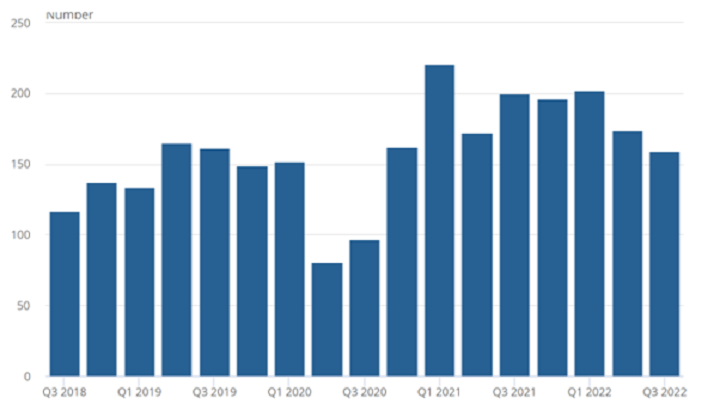
Overall, the number of acquisitions in UK companies from overseas investors increased above pre-pandemic levels in 2022 – this was fuelled by a weakening of the pound, albeit after Q2 2022. cross-border activity slowed due to geopolitical uncertainty following Russia’s invasion of Ukraine.
The number of inward M&A between Quarter 3 2018 and Quarter 3 2022
Source: Office for National Statistics – Mergers and Acquisitions Survey
In 2023 UK logistics businesses will remain attractive as a gateway into Europe. However industry operators using old technology and legacy systems are considered less reliable and may not be in a position to provide clients with the information necessary to ensure a seamless flow of goods to and from the European Union. Proactive 3PL providers that have invested in next generation logistics technologies, such as WMS systems, order fulfilment software applications and other cloud-based platforms; and those that are knowledgeable of changes to post Brexit customs procedures are likely to be more attractive to acquirers and investors as they will be able to demonstrate the ability to retain those clients seeking to outsource their international supply chain management.
Conclusion
The UK 3PL market remains highly fragmented and is made up of approximately 14,900 active providers, of which the majority are small to medium-size firms focusing on local business and supply-chain-function specific markets. As a result, there will undoubtedly continue to be a significant level of consolidation in the sector.
Notwithstanding this, the concerns slowing M&A at the end of 2022 will linger and are likely to result in both a hardening of prices and / or deals structured with an element of earn-out in those circumstances where sellers remain bullish about the prospects of growth and expect to be fully compensated for it.
For over 30 years, HMT has advised hundreds of ambitious entrepreneurial businesses, helping them to build and realise value. Our recent sector experience has given us access to numerous trade acquirers and institutional investors seeking acquisitions in the sector, and we would welcome the opportunity to have an initial conversation to share some of the insights we have as well as to understand the ambitions of any shareholders or management teams contemplating a transaction.
Throughout 2020 and 2021, an acceleration in e-commerce and pressure on global supply chains, principally brought about by the pandemic, drove updemand for transport and logistic services and, therefore, freight prices. M&A activity followed suit as sellers were enticed by growing valuation multiples, and buyers were drawn to the sector because of the significant changes occurring, the magnitude of which could potentially reinvent the sector.
However, in the latter half of 2022, the tightening of pricing on last mile delivery, the stabilisation of supply chains, increased energy / fuel costs brought about the Ukraine conflict, ongoing tightening of the labour market and an increased capital cost have cooled the red-hot deal activity of the past 24 months.
Going into 2023, the e-commerce market continues to swell, with contemporary consumer trends, which have accelerated during the pandemic, and modern consumption habits indicating pure-play online retailing is likely to continue to grow. Accordingly, cost-conscious businesses and the e-commerce market are expected to be avenues for sustained growth in logistics outsourcing. According to Insider Intelligence, e-commerce sales are forecast to grow annually by approximately 4.2% between 2022 and 2026, outpacing non-e-commerce which is forecast to grow annually by 2%, evidencing the growth opportunities for 3PL providers in the e-commerce market. This combined with an ongoing propensity for SME retailers to outsource 3PL services to manage committed operating costs continues to provide growth for the market.
Key Sector M&A drivers in 2023
Market consolidation
Whilst overall M&A activity cooled in 2022, the industry was dominated by consolidation in what remains a fragmented market. The largest transaction in the sector in 2022 saw Clipper Logistics acquired by GXO (formerly a fulfilment division of XPO which was carved out and separately listed in 2021), who sought to consolidate their position in the UK market.
In the mid-market, the consolidation trend we’ve seen over the past ten years is set to continue, fuelled by a significant level of buy and build activity from PE backed businesses. With institutions needing to deploy significant levels of dry powder, and with exceptionally strong balance sheets across both large international logistics companies and mid-market operators, many remain keen to acquire businesses in growing areas of the industry.
With the industry seemingly destined to become dominated by fewer, bigger businesses; SME market participants lacking operational scale may struggle more with challenging economic conditions and suffer a reduced ability to compete. This may be compounded by the need to invest in new low-carbon delivery methods and other sustainability-focused technology in order to satisfy their customers’ growing ESG requirements. As companies consolidate, merge, and invest, smaller businesses will need to stay competitive by enhancingtheir service proposition to clients to thrive.
For many of the more established mid-market operators, the cash generated during the strong pandemic years has been re-invested into state-of-the-art facilities and there is now a push to increase utilisation by acquiring smaller, less efficient businesses to consolidate into these new premises, which will enable them to generate quick synergies.
Vertical integration
Traditional retailers, not just logistics companies, have made a big splash in the M&A market, causing heightened acquirer demand, and pushing valuations higher. In the US for example, Quiet Logistics, a rapidly growing third-party logistics provider with a focus on e-commerce, was acquired by American Eagle Outfitters in December 2021 for a total enterprise value of $360 million. Quiet Logistics will join American Eagle as their second logistics acquisition of 2021, followingr its acquisition of AirTerra in August 2021. What happens in the US tends to be a pre-cursor for M&A activity in the UK, and in September 2022 Marks & Spencer Group plc acquired Gist Ltd, the local supply chain specialist and solutions provider, from Linde plc for £255 million.
These acquisitions demonstrate how retailers are leveraging logistics as a strategic tool where scale allows, bringing fulfilment back in-house to reduce costs and generate efficiencies within their own businesses. Many are retaining third party customers within these sites to benefit from the operational scale of the acquired business and creating a positive contribution to what would historically have been a cost centre.
Inbound Investment
Overall, the number of acquisitions in UK companies from overseas investors increased above pre-pandemic levels in 2022 – this was fuelled by a weakening of the pound, albeit after Q2 2022. cross-border activity slowed due to geopolitical uncertainty following Russia’s invasion of Ukraine.
The number of inward M&A between Quarter 3 2018 and Quarter 3 2022
Source: Office for National Statistics – Mergers and Acquisitions Survey
In 2023 UK logistics businesses will remain attractive as a gateway into Europe. However industry operators using old technology and legacy systems are considered less reliable and may not be in a position to provide clients with the information necessary to ensure a seamless flow of goods to and from the European Union. Proactive 3PL providers that have invested in next generation logistics technologies, such as WMS systems, order fulfilment software applications and other cloud-based platforms; and those that are knowledgeable of changes to post Brexit customs procedures are likely to be more attractive to acquirers and investors as they will be able to demonstrate the ability to retain those clients seeking to outsource their international supply chain management.
Conclusion
The UK 3PL market remains highly fragmented and is made up of approximately 14,900 active providers, of which the majority are small to medium-size firms focusing on local business and supply-chain-function specific markets. As a result, there will undoubtedly continue to be a significant level of consolidation in the sector.
Notwithstanding this, the concerns slowing M&A at the end of 2022 will linger and are likely to result in both a hardening of prices and / or deals structured with an element of earn-out in those circumstances where sellers remain bullish about the prospects of growth and expect to be fully compensated for it.
For over 30 years, HMT has advised hundreds of ambitious entrepreneurial businesses, helping them to build and realise value. Our recent sector experience has given us access to numerous trade acquirers and institutional investors seeking acquisitions in the sector, and we would welcome the opportunity to have an initial conversation to share some of the insights we have as well as to understand the ambitions of any shareholders or management teams contemplating a transaction.